
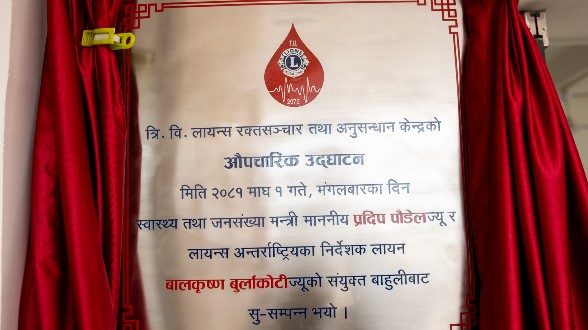
TU Lions Blood Bank: An 11-Year Journey to Build
TU Lions Blood Bank: An 11-Year Journey to Build One of Nepal’s Most Advanced Blood Banks
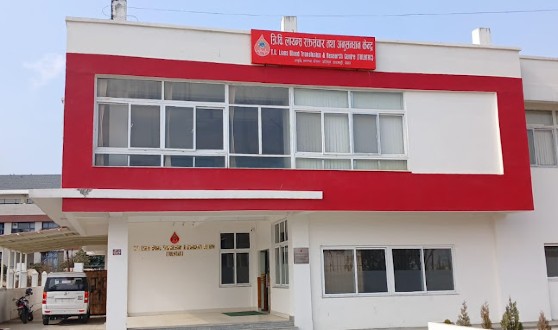
The TU Lions Blood Transfusion and Research Centre (TU Lions Blood Bank) is possibly one of the largest and most advanced blood bank projects established with support from the Lions Clubs International Foundation (LCIF). It has been developed with the capacity to collect large volumes of blood, separate blood into components, and safely store blood and blood components.
The Blood Bank has received “A” Grade recognition from the Government of Nepal, establishing it as one of the highest-grade blood banks in the country. With modern technology, advanced equipment, infrastructure, and professional management, it represents an important milestone in Nepal’s blood transfusion sector.
How Was TU Lions Blood Bank Made Possible?
This project did not happen overnight. It is the result of approximately 11 years of continuous effort, dedication, financial contribution, and institutional collaboration by Nepali Lions.
Due to the legal and administrative processes required by the Government of Nepal, the project took considerable time to move forward. It took nearly three years just to obtain the Letter of Interest. After completing building construction, installing advanced equipment, recruiting staff, and fulfilling other requirements, it took approximately two more years to obtain the operating license.
After nearly 11 years of continuous efforts, TU Lions Blood Bank has now been in operation for about two years.
A Joint Initiative of Tribhuvan University and Lions
The project was initiated as a joint effort between Lions Clubs International MD 325 Nepal and Tribhuvan University (TU).
Tribhuvan University provided the land required for the Blood Bank.
In the first phase, approximately 1,200 Lions Founder Members contributed NRs. 25,000 each, providing the initial funding to begin construction of the building.
In the second phase, proposals were submitted to the Lions Clubs International Foundation (LCIF) for a US$100,000 Matching Fund and approximately US$400,000 in Designated Funds.
After both grants were approved, work proceeded on building finishing, procurement, installation, and commissioning of modern blood bank equipment.
As additional financial resources were required to complete the project, approximately 2,000 additional Founder Members joined the initiative.
The project also received support from Kathmandu Metropolitan City and Lalitpur Metropolitan City, with contributions of approximately NRs. 5 million and NRs. 3.5 million respectively, along with support from the America Nepal Medical Foundation (ANMF), Nepal Investment Mega Bank CSR Fund, and other supporters.
Through these institutional and public contributions, today’s TU Lions Blood Bank became possible.
Modern Technology and Equipment
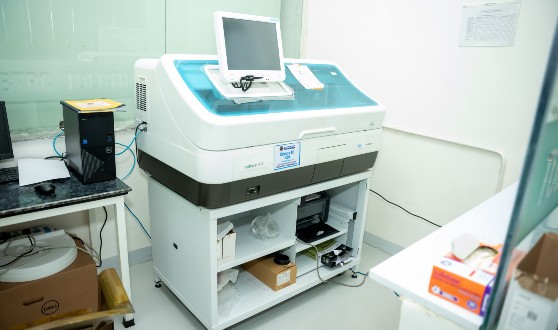
At a time when only a small proportion of blood banks in Nepal are equipped with modern technologies and equipment, TU Lions Blood Bank has prioritized modern systems throughout the entire blood service process from blood collection and testing to component separation, quality control, storage, and distribution.
Major technologies and equipment include:
• Roche eCLIA – for blood testing
• Bio-Rad – for blood grouping and compatibility/cross-matching
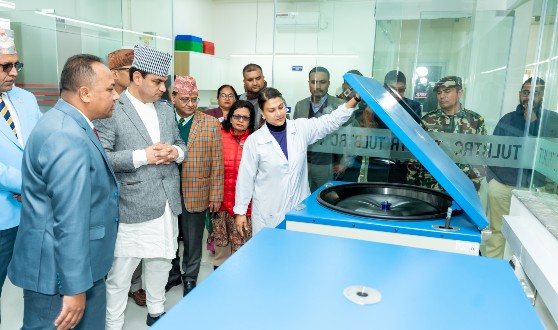
• Centrifuges – for blood component separation
• Automated USFDA-standard equipment – for quality-control testing
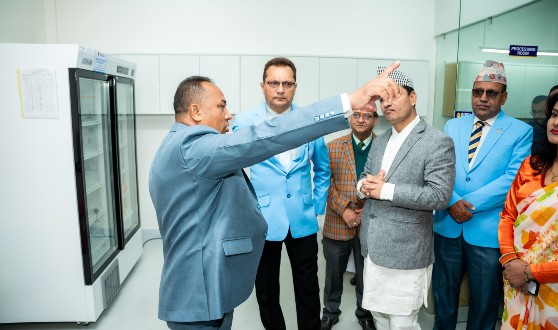
• High-capacity cold storage and freezer systems – for safe storage of blood and blood components
The Blood Bank has also been developed with significant storage capacity and infrastructure compared with many other blood banks in Nepal.
Blood Collection, Component Separation and Storage Capacity
TU Lions Blood Bank has been developed with a long-term target of reaching an annual blood collection capacity of approximately 50,000 units.
Our objective and system are designed to achieve 100% blood component separation, allowing collected blood to be separated into components and significantly increasing the availability of blood products for patients according to their clinical needs.
The center also has high-capacity cold storage and freezer systems for the safe storage of blood and blood components.
Our objective is to systematically manage the complete process:
Blood Collection → Testing → Component Separation → Quality Control → Storage → Distribution
Two Major Objectives
TU Lions Blood Bank has two principal objectives.
1) Blood Research through Tribhuvan University
Tribhuvan University aims to promote research in Blood Banking and Transfusion Medicine through this centre.
Institutionalizing university-level research in the field of blood banking and transfusion medicine is an important and historic initiative for Nepal.
2) Blood Collection and Humanitarian Service through Lions
Nepali Lions will contribute through blood donation campaigns, blood collection programs, infrastructure development, and blood distribution services according to community needs.
However, this project does not belong only to Nepali Lions.
It is a project built with the support and contributions of the people of Nepal, Nepali Lions, Lions around the world, and numerous national and international organizations. We are committed to developing it as a project that Nepal can proudly call its own.
TU Lions Blood Bank is a non-profit humanitarian project operated and overseen through the collaboration of Tribhuvan University and Lions Clubs International MD 325 Nepal.
Blood Irradiator: Another Historic Step for Nepal’s Blood Banking Sector
TU Lions Blood Bank is installing an X-ray-based Blood Irradiator Machine. With this technology not currently available at other blood banks in Nepal, its installation will further expand the range and capability of services that can be provided by TU Lions Blood Bank.
The equipment is being installed with support from a relevant agency of the U.S. Government, while the machine itself is manufactured in Canada.
Why is a Blood Irradiator Important?
An X-ray Blood Irradiator is used to provide appropriately irradiated blood components for patients who have specific clinical indications. Blood irradiation helps prevent donor T-lymphocytes from proliferating and thereby reduces the risk of Transfusion-Associated Graft-versus-Host Disease (TA-GVHD), a rare but potentially life-threatening transfusion complication.
However, one important point must be clearly understood:
Blood irradiation and blood testing are not the same thing.
Irradiation does not replace screening for HIV, Hepatitis B/C, Syphilis, or other transfusion-transmissible infections. Safe blood requires proper donor selection and screening, infectious-disease testing, blood component processing, quality control, irradiation when clinically indicated, and appropriate storage and handling.
The Next Phase
At present, some of our critical equipment is available as a single unit/system, which can create challenges in maintaining uninterrupted 24-hour operations.
Therefore, our next priority is to develop equipment redundancy and backup capacity so that critical blood bank services can continue without interruption even when equipment requires maintenance or experiences technical problems.
We are preparing to move forward with proposals to the Lions Clubs International Foundation (LCIF) through various Matching Fund projects to secure additional equipment, technology, and systems.
Our Goal Is Clear:
To build an exemplary blood bank capable of providing safe, high-quality, modern, and research-based blood transfusion services to Nepal.
This is not simply a building or equipment project.
It represents 11 years of dreams and dedication by Nepali Lions, the contributions of thousands of Founder Members, the partnership of Tribhuvan University, the support of LCIF and numerous national and international donors, and the trust of the people of Nepal.
Therefore, TU Lions Blood Bank is a project that every Nepali Lion, every blood donor, every supporting organization, and every Nepali can be proud of.
🩸 Safe Blood 🩸 Quality Service 🩸 Modern Technology 🩸 Research
TU Lions Blood Transfusion and Research Centre
Tribhuvan University & Lions Clubs International MD 325 Nepal
Written by: Lion Man Bahadur Roka Past Council Chairperson, MD 325 Nepal Vice President, TU Lions Blood Transfusion and Research Centre
 Copy Link
 Return to Homepage